Heat Pump vs. Trivolt: Why Swiss Heating Math is Changing
Are you building a new Minergie-standard home, renovating an apartment in Zurich, or planning a chalet in the Alps? Everyone is probably giving you the same advice: "Install a heat pump." It is the standard. It is common. It is the safe choice.
But is it really the most economically sound one?
In Switzerland, where labor costs and building space are among the most expensive in the world, the tide is turning. We looked at hard data, lifespans, and real heating costs to compare heavy machinery (heat pumps) with modern physics (Trivolt infrared technology).
The Result: Heat pumps suffer from "over-engineering syndrome" and are an economically unrecoverable investment for modern, highly insulated homes.
1. "Over-engineering Syndrome": Why the Standard Isn't Always Optimal
How It Works: Machine Room vs. Physics
To understand the difference in price and efficiency, we must understand the difference in technology.
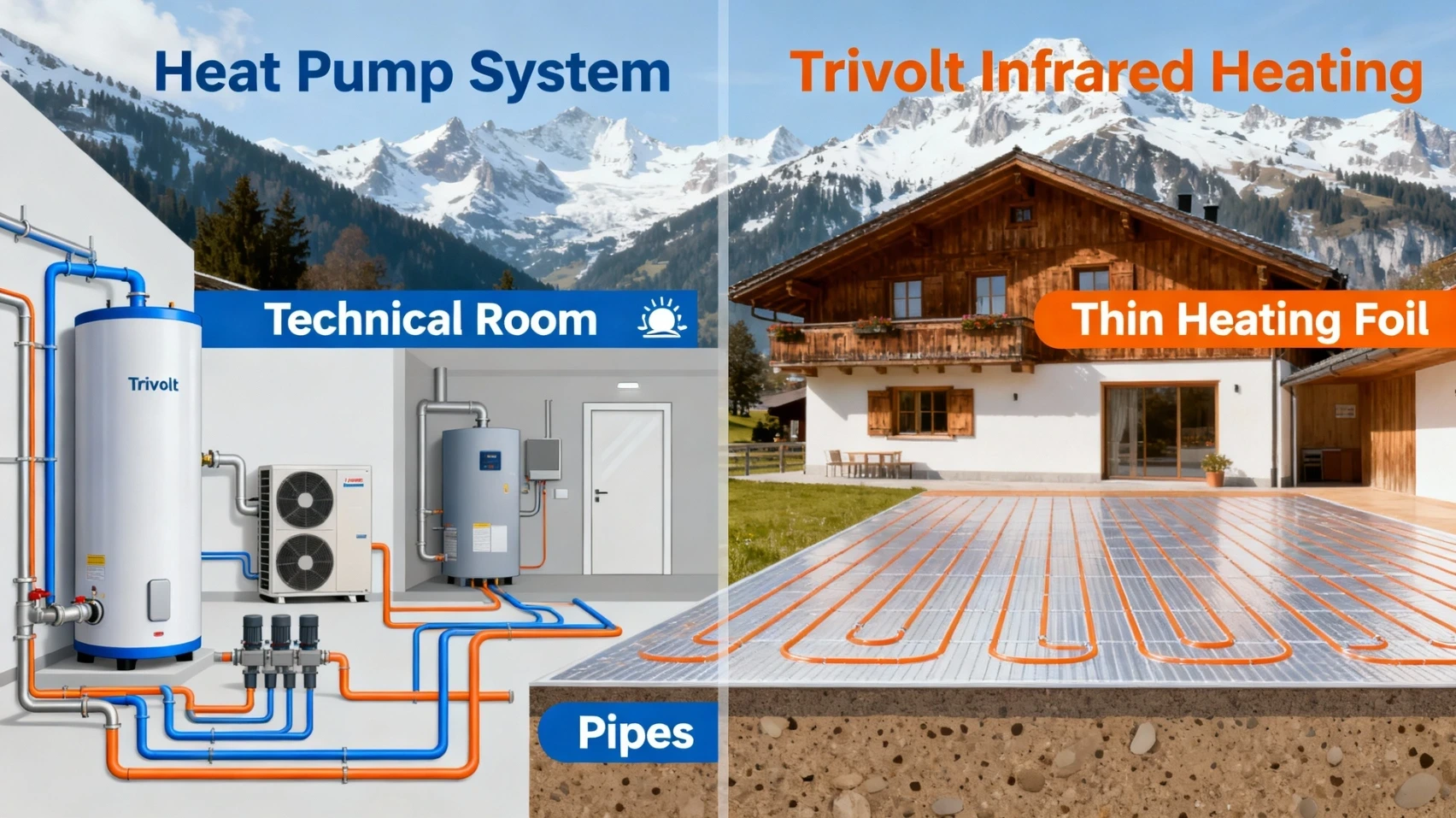
Heat Pump (Complex Chemistry): Imagine it as a "reverse refrigerator." It is a complex machine full of refrigerant, compressors, fans, and heat exchangers. It takes energy from the air (or ground) and pushes it into the floor through a complex system of water pipes.
Risk: Contains dozens of moving parts. What moves, breaks.
Space: Requires a technical room, an outdoor unit (noise), and thick concrete screeds.
Complexity: The more parts, the more places something can go wrong.
Trivolt Infra (Clean Energy): Trivolt works on the principle of radiant heat—just like the Sun. Electric current passes through a special nano-carbon layer, which heats up instantly. No water, no pipes, no boiler.
Advantage: No moving parts. The foil is only a few millimeters thick and is installed directly under the floor.
Efficiency: 99% of electrical energy is converted into heat. Instantly.
Simplicity: Physics is simpler than mechanics.
2. The Efficiency Myth: When Does the Pump "Lie"?
Vendors argue with COP (Coefficient of Performance). They say: "Our pump produces up to 4 kW of heat from 1 kW of electricity!"
This is true, but only in a lab at +7°C. Here we meet the key problem: Although a heat pump has 3–4× lower electricity consumption, its CAPEX (capital expenditure) and hidden construction costs in Switzerland are so extreme that, given the low energy needs of a modern home, the return on investment exceeds the lifespan of the device itself (15 years).
What is the reality in Swiss conditions?
Freezing Temperatures: When the temperature in the Alps drops to -10°C, the efficiency of the heat pump (air-water) drops radically. Electricity consumption rises exactly when you need heating the most.
Lifespan: A heat pump compressor lasts on average 12–15 years. Then you face a replacement (investment approx. CHF 15,000).
Trivolt: Has constant 1:1 efficiency regardless of whether it is +10°C or -20°C outside. And more importantly—it lasts 30 to 50 years without service.
The Money Reality: You pay CHF 50,000 upfront to save CHF 800 annually.
3. The Space Tax: The Hidden Cost No One Mentions
In Switzerland, space costs more than energy.
This is the most important fact that will change your perspective on investment.
In Switzerland, residential construction space costs approx. CHF 3,000 – 4,000 per m².
A heat pump requires a technical room (Technikraum)—space for the indoor unit, boiler, and buffer tank.
| Item | Heat Pump | Trivolt |
|---|---|---|
| Space Required | 3–4 m² | 0 m² |
| Real "Loss" of Value | CHF 12,000 | CHF 0 |
| What Could Be There? | A wall with a mandatory machine | Sauna / Wine Cellar / Larger Bathroom / Office |
Imagine it this way: Trivolt just earned you CHF 12,000 in space you didn't have to sacrifice.
Ask yourself: "Do you already have a technical room planned? What would you do with that room if it were free?"
4. Model Calculation: Money Reality (150 m² Home)
Let's calculate. Let's take a realistic scenario:
House: Modern, low-energy house (Minergie standard), where heat barely escapes.
Size: 150 m²
Heat Demand: 4,500 kWh/year (very low—that is why a HP is unnecessary)
| Item | Heat Pump (Air-Water) | Trivolt Infra System |
|---|---|---|
| System Price + Installation | CHF 35,000 | CHF 12,000 |
| Floor Distribution (Pipes) | CHF 5,000 | CHF 0 (included) |
| Technical Room (approx. 4 m²) | CHF 14,000 (construction cost) | CHF 0 (not needed) |
| Annual Service | CHF 400 | CHF 0 |
| TOTAL INITIAL INVESTMENT | CHF 54,000 | CHF 12,000 |
| Annual Energy Cost | ~CHF 450 | ~CHF 1,440 |
| TOTAL ANNUAL COST | CHF 850 | CHF 1,440 |
Result for the Investor:
With Trivolt, you pay ~CHF 590 more annually for electricity.
BUT you saved CHF 42,000 upfront on the initial investment and construction costs.
Key Question: How many years would it take to recover the saved money just for the higher operating costs?
Answer: 71 years.
Conclusion: A heat pump in a modern house with low consumption will die 2–3 times before it even pays for its installation compared to Trivolt.
5. Suitability for Property Types (Swiss Guide)
🏢 City Apartment / Loft (Zurich, Geneva): Winner: Trivolt. No space for a technical room, no noise allowed. Trivolt is invisible.
🏔️ Alpine Chalet (Zermatt, Davos): Winner: Trivolt. Heat pumps freeze and lose efficiency at -15°C. Trivolt has no water to freeze and works perfectly. You can control it remotely via Wi-Fi.
🏗️ New Build (Minergie): Winner: Trivolt + Photovoltaics. The house needs minimal heat. Investing heavily in machinery is nonsense. Use the saved capital for solar panels.
🏡 Old Stone House (Uninsulated): Winner: Heat Pump. High consumption (15,000+ kWh) justifies the COP efficiency. Trivolt is recommended only after insulation.
6. Three Arguments: Gain Space, Invest Smart, Zero Maintenance
Gain Space: A heat pump needs a technical room. Trivolt needs 0 m². Saved 4 m² means space for your sauna or wine cellar. In a world where a m² costs CHF 4,000, Trivolt just earned you CHF 16,000.
Invest Smart: Modern houses need precise heating, not strong heating. Installing a heat pump in a low-energy house is like buying a bus for a two-person family. Trivolt reduces upfront costs by 70%. Invest the saved capital in Swiss stocks or solar panels, not pipes in concrete.
Zero Maintenance: No annual inspections. No compressor replacements after 15 years. No water leaks. Trivolt is solid state. Install it and forget it for 50 years.
Conclusion: Don't Buy Heating from the Last Century
Why pay for a technical room, mandatory revisions, and expensive installation when you can have a system that:
Costs a third of the price.
Takes up zero space.
Lasts longer than the floor itself (50 years).
Works reliably even in the deepest frost (-20°C).
Trivolt brings Swiss precision to your home. Fewer parts, fewer worries, more heat.
Get a non-binding calculation for your project and find out how many thousands of francs you can save with the right decision.