Are you wondering why your energy bills are so high in your home or apartment? The answer lies in heat loss, which could be robbing your household budget of hundreds of euros.
A building’s heat loss is a key factor in correctly sizing a heating system. It represents the energy needed for heating, hot water preparation, cooling, ventilation, and lighting. In a new build, this value is included in the project documentation. To calculate it accurately, specialized software is used—taking into account variables such as wall thickness, insulation of walls, ceilings, floors, and more. In older buildings, a certified firm can calculate exact losses through a so-called thermal-technical assessment or an energy audit.
What influences the value of heat loss?
Heat loss through ventilation occurs when warm air escapes via open windows or leaks in the building envelope. In recent years, heat recovery has been widely used to reduce this form of loss. Its role is to ensure sufficient air exchange while simultaneously pre-heating incoming air so that cold air doesn’t enter the room and increase heating costs.
Beyond ventilation, heat loss is affected by factors such as:
The type and height of the building
The shape of the building
The orientation of the structure by cardinal directions
The ratio of windows to walls in the external shell
Thermal bridges
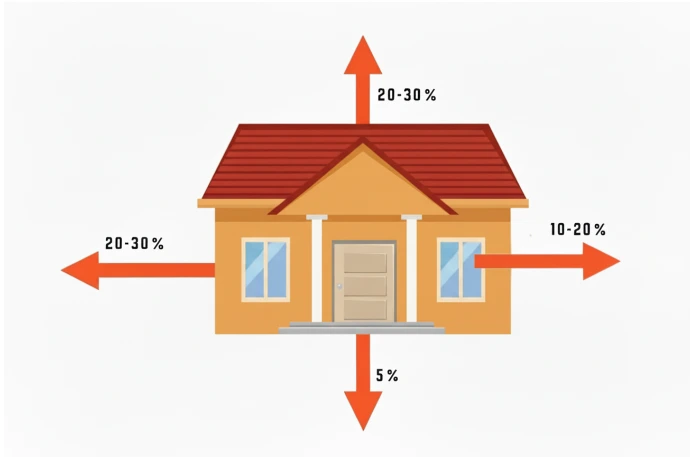
The greatest heat losses in a home
Up to one-third of heat loss in a home comes through the external walls, about 20 % through the roof or insufficiently insulated attic space, and another 20 % may be caused by inferior windows and exterior doors.
How to reduce heat loss in your home
Regardless of whether you’re working with a new build or renovating an older structure, you can reduce heat loss by implementing actions such as:
Ensuring a continuous building shape and optimal orientation
Eliminating thermal bridges—e.g., by insulating concrete lintels and other construction weak points
Investing in high-quality windows with triple glazing and well-insulated frames
Installing a heat-recovery ventilation system
Ensuring excellent insulation of walls, ceilings, floors
Every building is unique in its construction, which is why it’s important to consult a designer or specialist company when seeking the right heating solution. They can recommend how to reduce your home’s heat loss and guarantee low operating costs in the long run allowing you to redirect the savings toward something else.
Translating heat loss into cost
Heat loss is expressed in terms of kWh/m² per year or MWh per year. When calculating per square meter, it must be multiplied by the heated area to get the total.
Example: if a house has heat loss of 25 kWh/m²/year and a 130 m² heated area, the total consumption is 25 × 130 = 3,250 kWh. At a rate of about €0.17 per kWh, the annual cost is roughly €552, which equates to €46 monthly.
If you want your heating system properly sized so that your home stays warm even in the cold months, the heat loss must be respected and your heating system must deliver enough or even more than the required output. A system with a performance reserve will react more flexibly and reach the desired operational temperature faster.
You do not need to worry about increased energy consumption—the home will only use as much energy as is needed for heat loss, with additional heating controlled by a smart thermostat via mobile app.
For a quote or more information, feel free to contact us.